
A case by sea is hard to find, orders for China-Europe trains have soared, but railway tracks have become the biggest bottleneck?
Release time:
2021-10-09
On the 27th, the China-Europe train "Global Yida" loaded with 100 standard containers for export started in Yiwu, Zhejiang Province, heading for Madrid, the Spanish capital, 13052 kilometers away. A day later, the China-Europe train "Shanghai" loaded with 50 containers set off from Minhang to Hamburg, Germany, thousands of miles away, marking the successful start of the China-Europe train from Shanghai to Germany.
|
A case by sea is hard to find, orders for China-Europe trains have soared, but railway tracks have become the biggest bottleneck? |
|
On September 27, the China-Europe train "Global Yida" loaded with 100 TEUs for export started in Yiwu, Zhejiang Province, heading for Madrid, the Spanish capital, 13052 kilometers away. A day later, the China-Europe train "Shanghai" loaded with 50 containers set off from Minhang to Hamburg, Germany, thousands of miles away, marking the successful launch of the China-Europe train from Shanghai to Germany. Intensive starting, so that the Central European class in the National Day holiday also did not stop. The train inspectors ushered in a doubling of the workload of "each person used to inspect more than 300 vehicles a night a day, but now more than 700 vehicles a night a day. At the same time, the number of trains opened in the context of the global epidemic hit a record high for the same period. Official data show that from January to August this year, China-Europe trains operated a total of 10052 trains, exceeding 10,000 trains two months earlier than last year, transporting 967000 TEUs, an increase of 32 per cent and 40 per cent respectively over the same period last year, and a comprehensive heavy container rate of 97.9 per cent.
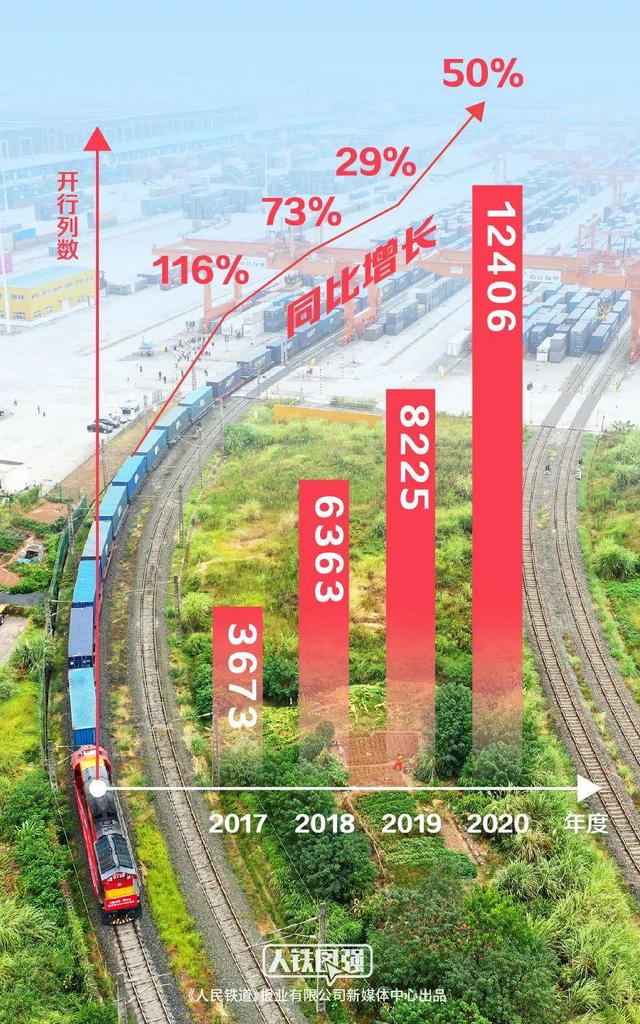
In the current international shipping "a box is difficult to find", freight and other background, China Europe class as a foreign trade enterprises to provide more yuan of choice. But at the same time, the rapid expansion of the China-Europe train is also facing many bottlenecks. China-Europe class under the outbreak ran out of "acceleration" The Chengdu-Chongqing region is the first city in the country to run the China-Europe train. According to data from Chengdu International Railway Port Investment Development Group, from January to August this year, China-Europe trains (Chengdu-Chongqing) opened nearly 3600 trains. Among them, Chengdu is steadily strengthening the three main lines of Rhodes, Nuremberg and Tilburg, innovating the operation mode of "Eurolink" and basically realizing full coverage in Europe. In 2011, Chongqing opened HP trains, and then many cities across the country opened freight trains to Europe one after another. By August 2018, the cumulative number of China-Europe trains operating across the country has achieved the annual goal of 5000 trains set out in the "China-Europe Train Construction and Development Plan (2016-2020)" (hereinafter referred to as the "Plan"). The rapid development of the European train during this period benefited from the "One Belt One Road" initiative and the inland areas actively seeking to establish an international logistics channel connected to the outside world. In the eight years from 2011 to 2018, the annual growth rate of China Europe train was more than 100 per cent. The most important jump was in 2014, with a growth rate of 285 per cent. The outbreak of the new coronary pneumonia epidemic in 2020, the impact on air and sea transport is relatively large, airport suspension, port closure and other reasons, the China-Europe train has become an important support to protect the international supply chain, the number of cities and the number of banks have increased significantly. According to the data of the National Railway Group, in 2020, the total number of China-Europe trains opened 12400 trains, the annual number of trains exceeded 10000 for the first time, an increase of 50 percent year-on-year; the cumulative delivery of goods 1.135 million standard boxes, an increase of 56 percent year-on-year, the comprehensive heavy box rate of 98.4 percent. With the gradual resumption of production around the world, especially since the beginning of this year, the demand for international transport has increased significantly, ports are congested, a box is hard to find, and shipping prices have also risen sharply. As a long-term observer of the international shipping field, Chen Yang, editor-in-chief of the professional shipping information consulting platform Sindh Maritime Network, told First Financial that since the second half of 2020, the tension in the container supply chain has not improved significantly, and this year's freight rates have repeatedly hit record highs. Even with the volatility, freight rates from Asia to the US-West are still more than ten times higher than before the outbreak. It is conservatively estimated that this situation will continue until 2022, and even some analysts believe that it will continue until 2023. "The consensus in the industry is that the bottleneck of container supply will definitely be unlocked this year". Citic Construction Investment also believes that the super peak season of the collection and transportation may be extended to a record, the epidemic superimposed on the impact of various events, the global supply chain chaos intensified, there is still no sign of improvement in the relationship between supply and demand. Although new small carriers continue to join the Pacific market, the overall effective capacity of the market remains around 550000 TEUs per week, which has no significant effect on the improvement of supply and demand. Under the outbreak, the ports have upgraded the control of the ships, exacerbating the delay of the shift and the contradiction between supply and demand. The unilateral market pattern caused by the serious imbalance between supply and demand may continue for a long time. Corresponding to the continued strong market demand is the "acceleration" of the Central European class in the outbreak ". Official data show that since the beginning of this year, the China-Europe trains entering and leaving the country through the Manzhouli Railway Port have exceeded the 3000 column mark. Compared with last year, the 3000 column tasks have been completed nearly two months ahead of schedule, showing a trend of sustained and rapid growth. According to the "China Europe train data report" issued by the State Railway Administration, in the first half of this year, the transport capacity of the three major channels was further improved. Among them, 3810 trains were opened in the western channel, with a year-on-year increase of 51%; 2282 trains were opened in the eastern channel, with a year-on-year increase of 41%; and 1285 trains were opened in the central channel, with a year-on-year increase of 27%. Under the tight international shipping and the rapid rise in freight rates, the China-Europe class provides a supplementary plan for foreign trade enterprises. Chen Zheng, general manager of Shanghai Xinlian Textile Import and Export Co., Ltd., told First Finance and Economics that the transportation time of the China-Europe train has now been reduced to about 2 weeks. The specific freight amount varies according to different agents. The freight quotation for the 40-foot container is currently about US $11000, while the freight for the sea container has now risen to nearly US $20000. Therefore, enterprises can save costs to a certain extent if they use the China-Europe train, at the same time, the transportation time is not bad. From August to September this year, a large number of Christmas supplies could not be shipped out in time because of "a box is hard to find. Qiu Xuemei, general manager of sales of Dongyang Weijiu Le Arts & Crafts Co., Ltd., once told First Finance and Economics that they were considering converting some goods destined for Russia or Middle East countries from sea transportation to land transportation for export. However, the rapid growth of the Central European train is still not enough to form a substitute for maritime transport. Chen Zheng said that the transportation of international goods is still dominated by sea, accounting for about 80%, while air transportation accounts for 10% ~ 20%. However, the proportion and volume of China-Europe trains are relatively limited, which can provide supplementary schemes, but cannot replace sea transportation or air transportation. Therefore, the symbolic significance of the opening of the Central European train is greater. According to data from the Ministry of Transport, in 2020, the container throughput of coastal ports will be 0.23 billion TEUs, while the China-Europe Express will transport goods 1.135 million TEUs. From January to August this year, the container throughput of coastal ports across the country 0.16 billion TEUs, while the total number of containers sent by China-Europe trains in the same period was 964000 TEUs. Yang Jie, commissioner of the International Train Consulting Service Center of the China Transportation Association, also believes that although the China-Europe train can replace only a very small number of goods, the channel role of the China-Europe train will undoubtedly be further strengthened. China-EU trade warming boosts China-EU train boom In fact, the current popularity of the China-Europe Express is not a temporary situation, and the reason behind it is not only because of the skyrocketing shipping costs. "China's advantages after the formation of the double cycle pattern were first reflected in its economic and trade relations with the EU." Wei Jianguo, former vice minister of the Ministry of Commerce and vice chairman of the China Center for International Economic Exchange, said that from the perspective of economic relations, from January to August this year, China-EU trade 528.9 billion US dollars, an increase of 32.4 percent, of which China's exports 322.55 billion US dollars, an increase of 32.4 percent, and China's imports 206.35 billion US dollars, an increase of 32.3 percent. Wei Jianguo believes that the EU is likely to surpass ASEAN again this year and return to China's largest trading partner. This also means that China and the EU will become each other's largest trading partners, and "China-EU economic and trade relations will usher in another village". Although the proportion of China-EU trade and economy currently carried by China-EU trains is quite limited, he predicts that China-EU trade will exceed US $700 billion, and with the rapid increase of China-EU trains, it will be possible to carry international transportation of US $40 billion -50 billion goods, with great potential. It is worth mentioning that many countries are paying more attention to the China-Europe train and improving the efficiency of customs clearance. "The ports of the China-Europe Express are better than those of the United States and ASEAN in terms of congestion relief and container handling. This allows the China-Europe Express to play a commando role in China-Europe trade." Wei Jianguo said, "Although it is not the main force, it has played a very good outpost role." This enterprise also has a greater feeling. Alice, the shipping manager of Youhe (Yiwu) Trading Co., Ltd., told China Business News that companies that originally exported to the United States have also increased their exports to the European market this year, with an increase of about 50% to Europe. This has further increased their attention to the Central European class. In terms of the types of goods transported, the goods transported by China-Europe Express have expanded from electronic products such as notebook computers in the initial stage to more than 50000 types of products such as auto parts and complete vehicles, chemicals, mechanical equipment, e-commerce parcels, medical devices, etc. The annual value of goods transported by the Express has increased from US $8 billion in 2016 to nearly US $56 billion in 2020, an increase of nearly 7 times. The situation of "empty containers" in China and Europe is also improving: in the first half of 2021, the return journey ratio reached 85%, the best level in history. The China-Europe train "Shanghai", which was launched on September 28, will give full play to the role of the return train in driving imports. In mid-October, the China-Europe train "Shanghai" will return to Shanghai from Europe, and a batch of audio from European countries, Large-scale sanitation vehicle locators, nuclear magnetic resonance equipment and other exhibits will enter the country on the train to participate in the 4th CIIE. Next, it will also take advantage of transportation efficiency and introduce more high-value goods such as red wine, luxury goods and high-end instruments into the Chinese market by cross-border railway. As one of the platform companies with the most complete lines, the most ports and the most accurate plan fulfillment in the domestic China-Europe train operation platform, Yixinou is the only privately-owned pioneer in the industry with a market share of 12% of the country's total shipments. It has also reaped several times the surge in return train and cargo value this year. From January 1 to October 1, 2021, the China-Europe (Yixinou) class train Yiwu platform opened a total of 1004 trains, a total of 82800 TEUs were shipped, an increase of 57.7 percent year-on-year. Among them, 770 trains were shipped on the way, up 23.8 percent year-on-year, and 234 trains were shipped on the way, up 1413.9 percent year-on-year. According to Yiwu Customs statistics, from January to August this year, the import and export value of Yiwu Customs through the "Yixinou" China-Europe train was 21.41 billion yuan, an increase of 82.2 percent over the same period last year, of which exports were 17.41 billion yuan, an increase of 50.6 percent over the same period last year, and imports were 4 billion yuan, an increase of 1955.8 percent over the same period last year. On August 19, the 3000th train of the "Yixin Europe" train yiwu platform set off. Platform operator Yiwu Tianmeng Industrial Investment Co., Ltd. issued a railway multimodal bill of lading, for the "railway multimodal bill of lading property rights" endorsement, trading enterprises with this bill of lading as a credential, to the bank to obtain "freight loan" or "goods loan" loan credit. This is a historic breakthrough in the business innovation of "railway multimodal bill of lading", marking the official landing of the "railway multimodal bill of lading" bill of lading issuance and bank credit business. Wang Jinqiu, chairman of Shanghai Oriental Silk Road Multimodal Transport Co., Ltd., said that the China-Europe train "Shanghai" has no government subsidies and is carried by platform companies that operate entirely on the market. Shanghai will also explore a new path as subsidies for China-Europe trains gradually decline. Infrastructure becomes a critical bottleneck Although China and Europe are showing explosive growth, they still face many problems. Congestion not only occurs in coastal ports, a large number of China-Europe trains gather, causing tremendous pressure on railway stations, especially railway ports. The China-Europe Express is divided into three passages: West, Middle and East, which exit through Alashankou and Horgos in Xinjiang, Erenhot in Inner Mongolia, and Manzhouli in Heilongjiang. Moreover, due to the inconsistency of railway standards between China and CIS countries, these trains need to change tracks through here. The International Association of Railways in 1937 stipulates that gauges of 1435mm are standard gauges, gauges above 1520mm are broad gauges, and gauges below 1067mm are counted as narrow gauges. Most countries in the world such as China and Western Europe implement standard gauge, but the CIS countries such as Kazakhstan, Kyrgyzstan, Uzbekistan, Tajikistan, and Russia use broad gauge. As a result, trains running on the "Pan-Eurasian Railway Main Line" cannot become "Eurasian Through Train". According to a person from a train company, due to the congestion at the port, in July and August this year, the National Railway Group reduced the volume of China-Europe trains of various train companies. Due to congestion, the timeliness of the China-Europe train is also limited. The head of the logistics department of an enterprise told First Finance and Economics that the company had previously imported some spare parts from Europe through the China-Europe train, but due to the higher timeliness requirements now, the China-Europe train could not meet the requirements and had transferred the goods to air transport for import. Wang Guowen, director of the Institute of Logistics and Supply Chain Management of China (Shenzhen) Comprehensive Development Research Institute, told China Business News that the bottleneck now lies in infrastructure. As far as China is concerned, it is okay to run 100,000 trains a year. The problem is to change tracks. From China to Russia, it is necessary to change tracks from standard tracks to broad tracks, and from Russia to Europe, it is necessary to change tracks from broad tracks to standard tracks. Two changes of track form a huge bottleneck. This involves the solution of track changing facilities and station facilities. A senior industry researcher said that the lack of infrastructure of the China-Europe train, especially the national railway infrastructure along the route, has caused a shortage of China-Europe train transportation capacity. The "Plan" also proposes to actively promote the joint formulation of Eurasian railway plans with countries along the China-Europe train, and steadily promote overseas railway construction. Accelerate the promotion of China-Kyrgyzstan-Ukraine, China-Pakistan and other railway projects preliminary research. Welcome the Mongolian and Russian railways to upgrade the old lines, improve the layout and supporting facilities and equipment of the border stations and replacement stations along the line, and promote the matching and connection of the railway line capacity of China, Russia and Mongolia. However, foreign infrastructure construction capacity is difficult to compare with China. Therefore, Wang Guowen proposed that the solution is to strive for all ports to introduce tracks and change tracks in China. With China's infrastructure construction capacity, the ability to change tracks can be greatly improved. At the same time, Wang Guowen also suggested that the original railway infrastructure in the domestic section should be strengthened, such as the transformation of bridges and tunnels and the opening of double-deck containers. "In recent years, we have paid more attention to passenger transport, but the freight infrastructure has not been greatly improved. Therefore, through the transformation of bridges and tunnels, the transportation volume has been increased and the economic reliability of train operation has been improved." Official sources of the State Railway Group also said that since the beginning of this year, the implementation of port expansion and renovation projects such as Alashankou, Horgos, Erenhot, and Manzhouli has effectively improved the capacity of China-Europe trains entering and leaving the country. From January to August this year, 5125, 1766 and 3139 trains were opened on the China-Europe Banlexi, Middle and East corridors, up 37 per cent, 15 per cent and 35 per cent respectively over the same period last year. In addition, the seventh meeting of the China-EU Joint Working Group on Express Transport was held by video conference on September 9. The meeting reviewed the "Measures for the Preparation and Cooperation of the China-Europe Railway Express Schedule (Trial)" and the "China-Europe Railway Express Transport Plan Agreed Measures" draft, and all parties agreed to sign it, which will further enhance the ability of domestic and foreign transportation organization. (Source: First Financial) |
Related News

Mobile:+860772-7507388
Mailbox:yxxs@hqfastner.com
Address: No.8, Xingtai Road, Chuanshan Town, Liujiang District, Liuzhou City, Guangxi Province


-Add WeChat-

-WeChat Public Number-

-TikTok-
Copyright©2024 Liuzhou Overseas Chinese Fastener Co., Ltd. All Rights Reserved. | SEO Tags | Business License | city substation
